Showing posts with label rare palm trees. Show all posts

Monday, March 4, 2013

Very Unusual Rare Banana Plant

 
Ensete ventricosum

Abyssinian Banana

This massive banana whose trunk can reach three feet in diameter is a real botanical curiosity. It is unbelievably fast growing and has carmine red undersides to the ribs of its huge leaves. It can be used as a summer bedding plant in cooler climates; otherwise plant it straight into the ground, and stand back.


Considered as the bestseller,Seeds are available at wholesale price,due to its extremely rarity which makes it hard to find the price are a little bit high..

11 seeds for 100 euro
49 seeds for 1000 euro
390 seeds for 10000 euro

All seeds are freshly and ship instantly after collected,giving it a 100%  rate of germination..

Check out how to get 100% germination,from tips to germination at the top of the blog

Friday, February 15, 2013

Fans Palm


Livistona chinensis
Chinese fan Palm, Fountain Palm
A much-loved fan palm that has been popular since Victorian times and makes a superb potted palm for the home or terrace. In warmer climates and over a period of years, it grows into a handsome, medium-sized tree with a slender trunk. The common name is something of a misnomer since it is actually native to Japan's Ryukyu Islands and Volcano Islands. The broad, lime green leaves have elegantly drooping and curled tips, which gives rise to its other name, "Fountain palm." The fruits, which are produced in large numbers, are blue. Livistona chinensis shows a good tolerance to cold and frost and may be used in the sheltered temperate garden, but will also happily accept hot and humid tropical conditions.

Livistona eastonii

Mitchell Plateau Fan Palm
A medium-sized, slender fan palm native only to the Mitchell Plateau in the Kimberley Ranges in northern Western Australia, where it grows in open, seasonally dry Eucalypt forest, occasionally in very dense stands. It forms a very slender, solitary trunk which with age can reach 20 m tall and supports a small, open crown of stiff leaves on long stalks. It is particularly well adapted to fire, which is a rather frequent occurrence in its habitat and helps the palm to compete with Eucalyptus and other trees. It is rarely seen in cultivation, perhaps on account of its slow growth, but would make a nice, robust and drought tolerant ornamental for the small, tropical garden.


Livistona decora
Ribbon fan Palm
A graceful, very fast-growing, tall palm from eastern Australia with finely divided, weeping fan leaves. It is easy to germinate, fast and easy to grow, and very adaptable and hardy in every respect--really a nearly foolproof palm. It has already been successfully tried as a landscape and even as an indoor plant on a commercial ba


Livistona lanuginosa
Cape River fan Palm

A robust Livistona from inland areas in N-Queensland, Australia, closely related to L. mariae. The Cape River fan Palm has fairly stiff, waxy, blueish leaves and large purplish fruits. It is best suited to drier climates and quite cold and even frost tolerant. Seeds are rarely available.
sis.


Livistona inermis
Wispy fan Palm

The Wispy fan palm is well named. It has a very narrow trunk and a small crown of deeply split, fan shaped leaves with very narrow segments.

Monday, January 10, 2011

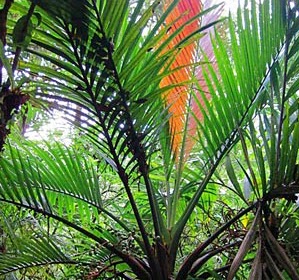
Alsmithia longipes (= Heterospathe longipes) A smallish palm with a slender, solitary trunk to 3.5 m (12 ft) tall that holds an open crown of ascending, bright green, pinnate leaves that unfold in a brilliant red. The fruits are rather large and bright red, the single seed is heavily sculpted and very easy to recognize. Alsmithia is very rare in cultivation as well as in its wild habitat on the Fijian Islands of Taveuni and Vanua Levu, where only a few hundred individuals persist, growing on steep slopes in extremely wet, dense rainforest to about 500 m (1600 ft.) a.s.l. Originally described by legendary palm botanist Hal Moore as Alsmithia longipes, it has recently been transferred to the genus Heterospathe, a questionable move, despite some DNA data in support. In cultivation, Alsmithia does best in a sheltered spot in the tropics.

Monday, June 7, 2010

Rare Fishtail Palm Trees

Exquisite Collection Of The Most Rarest Fishtail Palm Tree

Cayota Zebrina
(zebra fishtail palm)


Caryota Maxima Himalaya
(Himalyian or mountain fishtail palm)


Caryota Maxima
(ko chang fishtail palm)


Caryota Maxima
(Mountain fishtail palm)

Caryota Mitis


Caryota monostachya
(Dwarf fishtail palm)


Caryota No
(Giant fishail palm)


Caryota Obstusa
 (chinese giant fish tail palm)


Caryota Obtusa
(Giant fishtail palm)


Caryota Ochlandra
(chinese fish tail palm)


Indian Giant fishtail


All these fish tail palms are available for planting,