Showing posts with label palm trees. Show all posts

Monday, March 4, 2013

New available palm (King Palm) from australia

 
Archontophoenix alexandrae

King Palm

A very popular palm from Australia with grass green, feather shaped leaves with silver undersides and slender crown shafts. The small bright red fruits are produced in large quantities. The King- or Alexander palm will grow in a wide range of climates from tropical to cool temperate, and does excellently as an indoor palm given bright light. The seeds germinate easily and uniformly and subsequent growth is very fast.

Monday, January 10, 2011

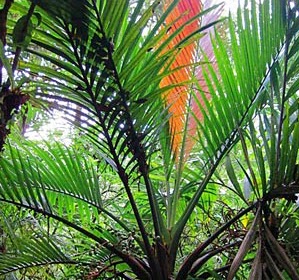
Alsmithia longipes (= Heterospathe longipes) A smallish palm with a slender, solitary trunk to 3.5 m (12 ft) tall that holds an open crown of ascending, bright green, pinnate leaves that unfold in a brilliant red. The fruits are rather large and bright red, the single seed is heavily sculpted and very easy to recognize. Alsmithia is very rare in cultivation as well as in its wild habitat on the Fijian Islands of Taveuni and Vanua Levu, where only a few hundred individuals persist, growing on steep slopes in extremely wet, dense rainforest to about 500 m (1600 ft.) a.s.l. Originally described by legendary palm botanist Hal Moore as Alsmithia longipes, it has recently been transferred to the genus Heterospathe, a questionable move, despite some DNA data in support. In cultivation, Alsmithia does best in a sheltered spot in the tropics.

Alloschmidia glabrata


A very rare palm that grows in the north of New Caledonia between sea level and 1200 m (3900 ft.) in wet forest. Its tall, slender trunk supposts a long crownshaft and about 10 elegant, ascending feather leaves. Because ripe seeds are extremely difficult to find, this species is almost never offered for sale. A must-have for collectors.

Saturday, May 29, 2010

Palm trees value up your home

Palm trees can add value to your home by spicing up your landscaping and giving your yard that exquisite and vibrant tropical look. A home with a beautiful, healthy-looking yard sells faster and for more. If you’re thinking of adding palm trees to your home, here are a few tips to keep in mind that should help you get the most out of your landscaping project.


When to Plant

The spring and summer months are the ideal time to start your palm tree landscaping project. Palm trees need warm weather and a lot of sun when they’re growing. If you already live in a tropical climate, you can start planting them at any time.


Do the Research

You don’t want to go into this project without knowing a little bit about the palm trees your thinking of getting. Look into the different types of palms and pay close attention to how wide and how tall each kind grows. You don’t want to end up with ones that are too big for your yard, or ones that have roots systems that could damage your foundation or other elements of the yard.


Don’t Plant Too Close to the House

Don’t make the common mistake of planting a palm tree too close to your house. Palm trees, when young, can look small and harmless, but they grow very quickly into giant tropical beasts that, if improperly placed, can take over your roof and damage your walls and windows.


Don’t Overcrowd

 Three palm trees or less is usually a good rule of thumb. You shouldn’t just start putting palms in every available section of your yard. Palm trees should work to frame the design of your yard and add a powerful tropical element to the landscaping, but they should not overcrowd your yard. Place your palms in different areas and arrange them organically, in a way that is visually appealing, rather than in evenly-spaced clusters or rows. Surrounding them with other plants and colorful elements is a great way to make your palms look even better.

Wednesday, May 26, 2010

Important tips to consider before planting your palm

In general, four factors should be considered when choosing a palm tree for your property. The first factor is the size of the tree at maturity. Remember that that little palm for sale at a local nursery might reach a height of 50 feet or more as an adult tree overpowering the rest of your property, interfering with overhead lines and underground conduits and perhaps, threatening buildings if the tree is planted too nearby. Make sure that the size of your palm at maturity is in keeping with your needs and overall landscape design.


The second factor is temperature . Most types of palm tree will not tolerate freezing weather and even a short bout of frost may weaken a tree and leave it vulnerable to insects and disease. In some, for example, the climate is simply too severe for successful palm growth. Check with your local nursery or tree expert for advice if you're unsure about growing conditions in your area.


The fourth factor is sunlight . Not all varieties of palm tree are equally sun tolerant. Some varieties, in fact, prefer shady conditions to full exposure. Keep this in mind when thinking of the kind of palm tree that would be best for you.


The final factor is water . While palm trees have long been associated with desert conditions, in the wild, they are only found near abundant and continuous supplies of water. If you are thinking about planting a palm tree on your property, make sure that the tree will receive adequate water and be prepared to water a newly transplanted tree frequently while it acclimatizes.